MVP Development Timeline: How Long Does It Take to Build an MVP?
We speak with founders every day who ask the same foundational question: “How long does it take to build an MVP ?” Understandably, an MVP development timeline drives planning, fundraising, runway management, and go-to-market strategy. But the honest answer isn’t a fixed number. Rather, it depends on the complexity of your product, the clarity of your scope, the technologies you choose, and the team model you adopt within the MVP development process.

Why Founders Bother with MVP Timelines
From our perspective, MVP timelines matter for three main reasons:
- Validation Before Investment: Investors want products that show traction, not just pitch decks.
- Investor Readiness: Investors want products that show traction, not just pitch decks.
- Runway Discipline: Every month you delay launch is another month of runway gone without learning whether your idea resonates.
A founder once said, “We’d rather spend 8 weeks getting 10 real customers than 8 months building a product we hope someone wants.” This summarizes the MVP mindset: move fast, learn fast, iterate based on real data while optimising the app development timeline.
How MVP Timelines Vary
We often tell clients that “MVP” isn’t a single template, it’s a spectrum. Some MVPs are lightweight and launch in weeks, while others with more moving parts take months. The MVP development timeline depends on:
- Product type and complexity
- Feature set (minimum vs. “nice-to-have”)
- Technology stack & tooling
- Team experience & model
- Compliance requirements (e.g., healthcare or fintech)
Research shows most MVPs take 8–16 weeks from concept to launch, with simple products aiming to build MVP fast on the lower end and complex products on the higher end.
MVP Development Phases & Time Breakdown
We structure the MVP development process into five major phases, each with its own purpose and time range.
1. Discovery & Requirements (1–3 Weeks)
This phase aligns the team and prevents scope creep later. In our experience, founders who skip discovery often end up reworking large parts of the product. Verifiable market guides confirm that discovery typically takes 1–3 weeks, depending on complexity. Before developers write a line of code, we work with founders to define:
- Core problem and user personas
- Target users and early success metrics
- What features an MVP should include
- Technical feasibility and risks
- Riseup Labs
Typical Time:
- Simple MVP: 1 week
- Medium MVP: 2 weeks
- Complex MVP: 3 weeks
2. UX/UI Design (2–4 Weeks)
Design is not just about aesthetics. It’s about shaping the user journey in a way that drives adoption. It is more significant for MVPs and heavily influences the timeline for mobile app development. In this phase, we:
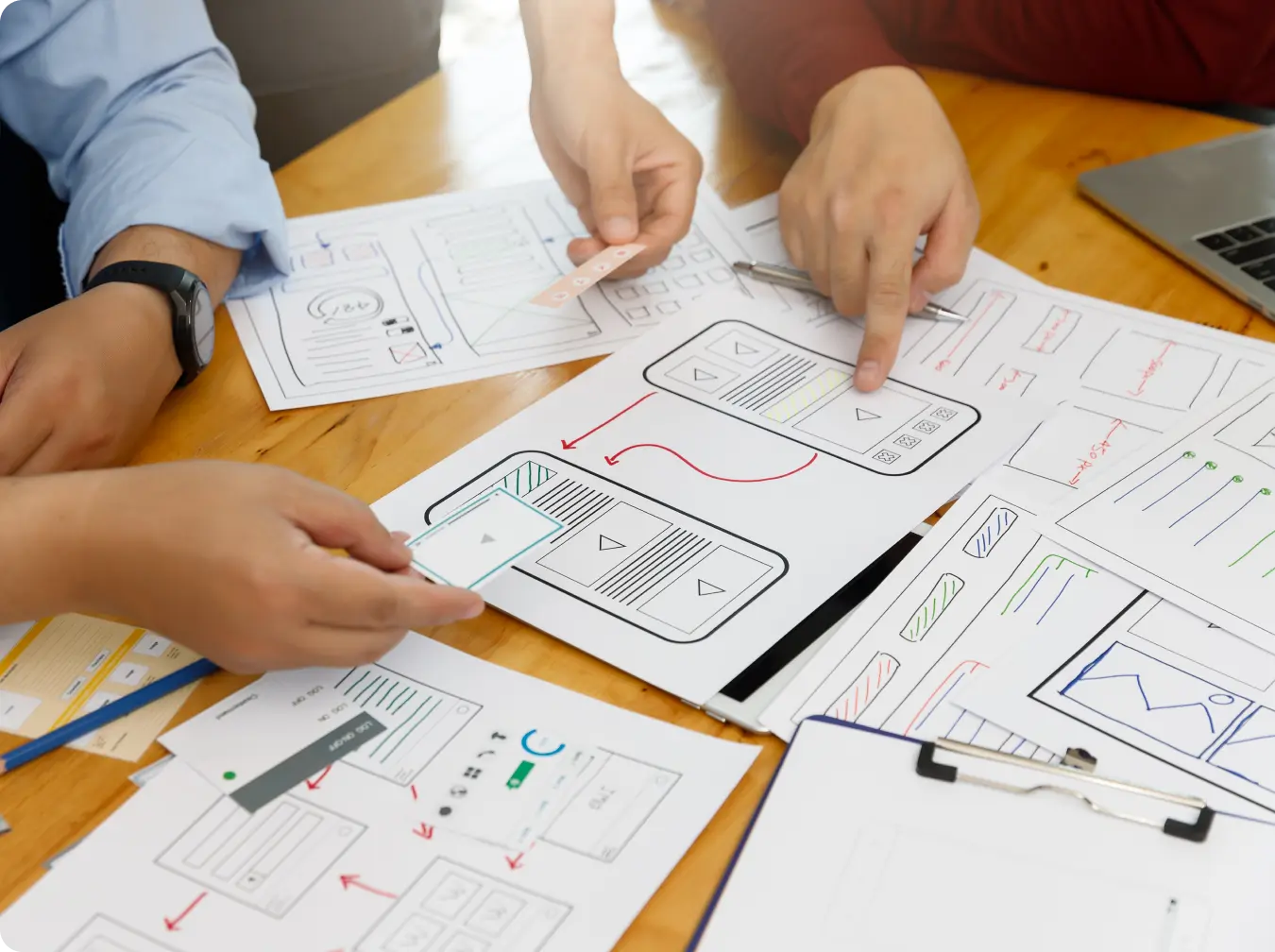
- Create user flows and wireframes
- Define UI style guides and design systems
- Build clickable prototypes for validation
Design timelines vary by refinement level. Simple flows are quicker, while tailored UI systems take longer.
Typical Time:
- Simple MVP: 2 weeks
- Medium MVP: 3 weeks
- Complex MVP: 4 weeks
3. MVP Development (6–14+ Weeks)
The bulk of the time is spent building the MVP. The engineering process involves:
- Frontend and backend development
- Database and API architecture
- Authentication, integrations, and business logic
- Infrastructure setup
It's often 6–14+ weeks, depending on complexity. The breakdown entails:
- Simple MVP: 6-8 weeks
- Medium MVP: 8-12 weeks
- Complex MVP: 12-14+ weeks
4. Testing & Quality Assurance (2–3 Weeks)
We sometimes hear founders say, “This is just an MVP, we can skip testing.” In our experience and according to verified sources, skipping QA can destroy your learning cycle and distort feedback.
QA includes
- Functional testing
- UI/UX validation
- Performance and security checks
- Cross-device/browser verification
Typical Time entails:
- Simple MVP: 1-2 weeks
- Medium/Complex MVP: 2–3 weeks
5. Launch & Iteration (Initial 1–2 Weeks)
Launch is more than pushing to production. For mobile products, store reviews can slightly extend the timeline for mobile app development. It entails:
- Deployment and app store submissions
- Analytics and tracking setup
- Initial feedback loops from early users
- Post-launch bug fixes and minor iterations
Typical Time:
- 1-2 weeks
“Speed matters. Fast beats slow more often than smart beats dumb.”
- Eric Schmidt
MVP Timeline by Complexity
Let’s break down timelines based on different levels of product complexity:
1. Simple MVP (4-8 Weeks)
These product types are ideal for early validation and getting something into the
consumers' hands quickly. Typical examples are landing pages, basic data capture
tools, and simple web apps with minimal logic. They usually take 4-8 weeks from
planning to launch.
Core traits include:
- One to two core features
- Minimal backend
- Limited integrations
2. Medium MVP (8–12 Weeks)
Medium MVPs are often the sweet spot for early revenue and fundraising. Typical
examples are SaaS platforms with user accounts, marketplace MVPs, and basic mobile
apps. Typically, they take 8-12 weeks.
Core traits:
- Authentication and user roles
- Backend logic & APIs
- Third-party services (email, payments)
3. Complex MVP (12–20+ Weeks)
Complex MVPs require thoughtful architecture and risk planning. Typical examples are
Real-time apps (chat, live updates), fintech or healthcare tools with compliance
constraints, and two-sided platforms. They take 12-20 weeks or more for the most
viable result.
Core Traits include:
- Real-time systems
- Multiple integrations
- Regulatory requirements
MVP Development Timeline by Tech Stack
Your technology choices have implications for the speed of MVP development and scalability in the long term.
1. React/React Native
React and React Native simplify frontend programming by using reusable components, along with their massive community support. For cross-platform MVPs, React Native enables building both web and mobile in an efficient manner. It helps to hasten the frontend programming process by minimising testing cycles.
2. Python / Node.js Backends
Python stands out as a prototyping tool and a data-intensive service-oriented system. Node.js enables the developer to easily implement real-time functionalities with ease because of the asynchronous nature involved.
3. Cloud Infrastructure( AWS, GCP, Azure)
Cloud reduces the time for setting up infrastructure. Managed services (serverless functions, databases) can save weeks during launch. Cloud reduces DevOps friction, making it easier to launch.
In-House, Freelancers, and Remote Teams
1. Hiring Delays
From our experience, delays in recruitment vary greatly depending on the models used:
- In-House Teams: In-house development team building is commonly the slowest method. It may take anywhere between 8 and 12 weeks or even more to select the candidates, negotiate the employment terms with the chosen candidates, and recruit the developers. Such activities slow down the start of the actual development work. Consequently, the MVP development will be delayed in the initial stages.
- Freelancers: Finding or hiring freelancers is always easier and faster compared to hiring full-time employees. That is because you can quickly integrate a skilled freelancer into your business operations. Still, there may be intermittent downtime when you can’t access the appropriate freelancer right away.
- Offshore Dedicated Teams: Most offshore partners have qualified engineers in place so that you can begin work in as little as 1-2 weeks. There's no need for a local hiring cycle, either, which eliminates many issues that come with directly hiring someone.
Execution Speed
The speed of execution is a function of team readiness and work coordination:
- In-House: The ability for assembled teams to easily shift and stay in sync with company culture can lead to improved execution later in the process. But this slow start will surely mean execution speed is of little value in MVP development.
- Freelancers: Freelancers have skills that are highly beneficial in speeding up certain tasks. However, in a case where there are no workflows or project management, working with multiple independent contractors slows everything down, especially in larger scopes of work.
- Offshore Teams: The speed offered by immediate availability is combined with structured delivery in offshore dedicated teams. This is because these teams work in an organised manner like units, thereby providing efficient delivery and predictable timelines. In the long run, this eliminates disorganised delivery that happens when you work with several freelancers and the time spent on in-house development.
3. Why Offshore Dedicated Teams Are Fastest to Start
From our experience, the offshore dedicated team approach always provides the fastest track to get things executed when founders prioritise rapid MVP development . Since the offshore team has talent resources and quality assurance resources available at all times, you can implement your idea quickly and keep this momentum going throughout the development phase with full-time recruitment overheads eliminated.
Offshore teams thus prove extremely useful for startups that seek rapid validation of their assumptions, control their burn, and want to learn from real user feedback instead of having to wait for internal recruitment processes.
Common Delays & How to Avoid Them
Here’s what slows down most MVP development projects and how you can overcome it:
1. Lack of Clear Scope
An undefined or expanding feature is the delay that can be prevented simply by locking MVP scope during discovery and refusing mid-build scope creep.
2. Too Many Features
Adding "nice to haves" to essentials destroys timelines. It makes the entire MVP development process overloaded and slows down the work speed. Prioritise ruthlessly only that work which helps to acquire basic learning and avoid common reasons for MVPs failure.
3. Poor Communication
When distributed teams lack a managed process to share updates, they tend to lag. Having daily stand-ups and managing documentation and tracking of progress is an area that cannot be ignored.
4. No Product Owner
Lack of a single decision-maker results in indecision. Make one of the founders or product managers the single decision-maker in time, even before any consultation begins.
Ways to Develop an MVP Quickly Without Compromising On Its Quality
“Fast doesn’t mean sloppiness; speed that doesn’t include quality will fail fast and consume your hard-earned money." “Here’s how we enable founders to deliver at a faster pace without sacrificing quality:”
- Define Clear Scope Early: Figure out the boundaries and deliverables early.
- Specialist Teams Working Exclusively On Your MVP: No multitasking, no context switching, just product progress.
- Parallel Design & Development: In some cases, overlapping of tasks like design and frontend setup compresses the app development timeline.
How Much Does It Cost to Build an MVP Fast in 2026?
While this article is about timelines, costs are the other side of the same equation. If you're comparing delivery models, team structures, and outsourcing strategies, read our full breakdown of MVP development cost.
- Simple MVPs: Cost about $4,500–$18,000 and take 3-10 weeks
- Mid-level MVPs: Cost about $9,500-$30,000, depending on integrations and quality.
- Complex MVPs: Cost approximately $30,000-$100,000 depending on features and compliance needs.
Ready to build your MVP even faster?
You must choose a team model if you are planning to enter the market with a product that does not have any launch delays. That is why Codevelo helps entrepreneurs jump into the execution phase with offshore expert dedicated teams to achieve speed, quality, and scalability.
Whether you are validating a concept, pitching to investors, or racing to the market, our team will help you define the scope of work, MVP development timeline, and provide you with an MVP that is ready for the real world. Arrange a free consultation with Codevelo today and acquire a roadmap that can enable you to produce your MVP faster and better.